
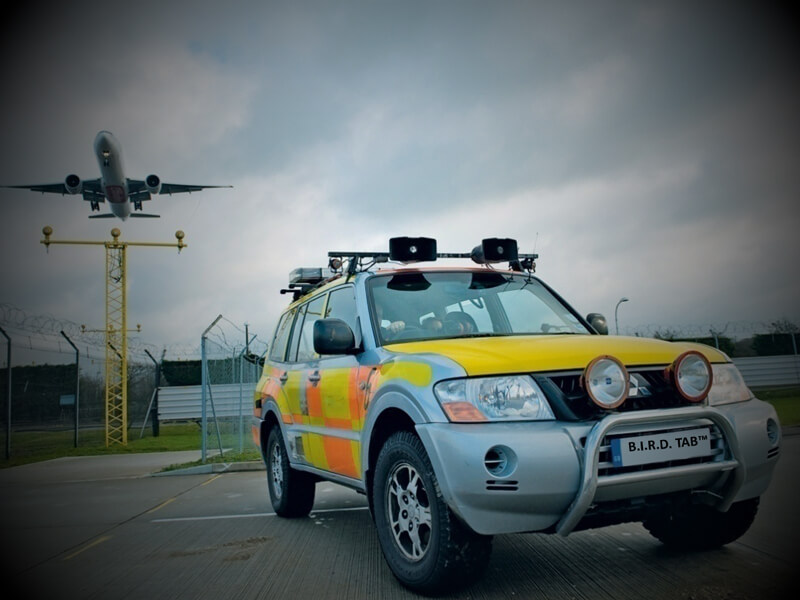
At Scarecrow, our range of bird dispersal solutions for airports heavily emphasises mobility. Our Premier 2020 and flagship B.I.R.D Tab are both vehicle-mounted solutions. We’re not alone in preferring movable solutions either. Guidelines from the International Civil Aviation Organisation (ICAO) recommend that audio bird dispersal systems should be mobile, and fixed systems should be avoided.
But why is that the case? What is wrong with, for instance, lining the runway with fixed speakers to keep it clear of birds? It sounds good in theory, but in practice there are a number of problems with fixed systems compared to movable ones.
Habituation
Birds become habituated to fixed systems far more easily than mobile ones, so those systems become less effective with time. A fixed system is, of course, always playing distress calls from exactly the same place. This does not mimic natural predator activity, and birds are smart enough to see the pattern, learn that there is no danger attached to calls from that location, and ignore them.
A mobile solution broadcasts from a different place every time. This much more closely mimics a real predator’s hunting activity, and prevents the calls from becoming routine. Mobile systems are therefore far better at retaining their effectiveness.
Danger
Bio-acoustic bird control at airports is supposed to be about keeping aircraft safe. However, fixed systems can potentially endanger them.
Birds react to distress calls in different ways. Species with a mobbing instinct, such as corvids, will initially fly towards the call to see if they are able to help the bird in distress. Only after failing to spot the predator will they decide to put safety first and leave the area.
Many fixed systems operate on a random play basis, as this can help mitigate the habituation problem discussed above. However, it also means a call can potentially go off just before or during an aircraft movement, drawing birds with a mobbing instinct to the runway at just the wrong moment and creating a risk of collision. A mobile solution, on the other hand, provides control over where the call is broadcast from and when, to avoid either drawing birds towards the runway or accidentally causing them to flee in the direction of a moving aircraft. Even for species without a mobbing instinct, a badly timed broadcast can cause stationary birds to take off at the worst moment and risk a collision.
Logging
Keeping records of wildlife hazard management activity is every bit as important as the activity itself. ICAO guidelines require comprehensive data logging for a number of reasons. It allows airports to analyse and understand wildlife activity in and around their airport in order to better refine their hazard management efforts, know what species to expect and when, and understand what is working and what is not. In the event there is a bird strike and questions start being asked by authorities, insurers, or the aircraft owner, having proper records will prove that all reasonable steps were taken to minimise risk and the airport cannot be held responsible.
Fixed solutions often work automatically, which does not lend itself well to recording whether birds were present and whether they were successfully dispersed. Even if they are triggered manually, this will typically be done remotely so key information will be missed such as what species were present and how they reacted to the call. Mobile solutions, in the hands of on-the-ground operators, are ideally suited to detailed record-keeping. Indeed, Scarecrow’s flagship B.I.R.D Tab provides operations teams with a complete, fully integrated dispersal and reporting system built around ICAO best practices.
Scarecrow offers a full suite of dispersal and record-keeping solutions for airports, which are mobile and designed for maximum, sustainable effectiveness. To find out more, click here or get in touch.